Arcane-Arena
🔥 Arcane Arena
Early access. The game is playable but still being built. Expect bugs, balance changes and missing spells.
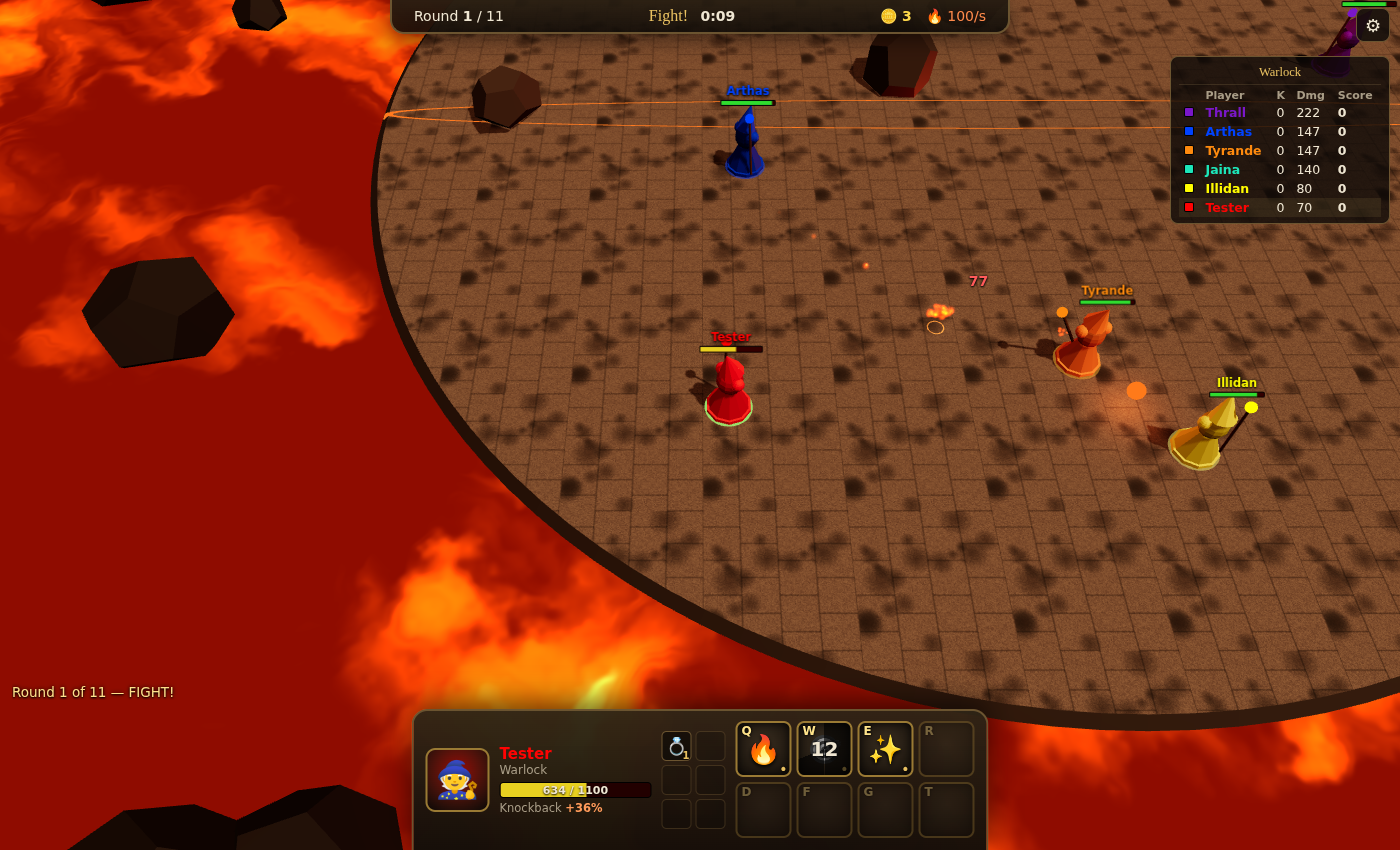
Arcane Arena is a browser remake of Warlock, the classic Warcraft III custom map. Every player is a warlock on a stone platform surrounded by lava:
- Knockback kills, not spells. Spells do little damage but knock you back, and every point of damage you take makes the next hit throw you further. The lava does the killing.
- Shrinking arena. The platform loses a tile every 15·√alive seconds.
- Rounds and shop. The last warlock standing wins the round. Kills, assists and round wins score a point each. Between rounds you buy and upgrade spells and items.
- Teams (optional). A lobby option splits everyone into 2, 3 or 4 teams. Players pick a team, and the host places the bots. Allies can’t hurt each other: spells pass through them. The last team standing wins the round, and every member gets the point, even those who fell. The team with the most points (its players’ points added up) wins the match.
Play: https://tenggames.com.au/arcane-arena/
Features
- Up to 10 players online. Peer-to-peer multiplayer with no game server: the host’s browser runs the match, and friends join with a 4-letter code or an invite link.
- Bots to fill the lobby or practise against.
- Warcraft III feel, measured in the real engine (docs/wc3-observations.md):
- The simulation runs in WC3’s 0.03 s steps.
- Movement: the heading turns 0.6 rad per step, and the unit walks only when its heading before the step is within the 60° propulsion window. Full speed at once, and it stops dead about 11 units short of the click.
- The drawn model turns more slowly than the unit steers, so after an about-face the warlock slides backwards for a moment, as in WC3.
- Casting: the warlock turns until it faces the target exactly, the spell goes off at once, then a 0.3 s cast point locks it. A right-click during the cast point waits for it instead of cancelling. The cooldown starts after the cast point.
- Knockback: a hit of D damage adds D·(100+M) units/s, where M is the damage taken this round including that hit. It decays ×0.96 per step, so a Fireball slides a fresh warlock 539 units. Warlocks that collide swap velocities.
- The original’s 100-HP scale. Lava is checked every 0.1 s.
- The default WC3 camera: distance 1650, 56° down. It doesn’t follow you: scroll with the screen edges or arrow keys, and press Space to centre.
- Green order-confirmation arrows, the blue targeting reticle, and “Spell is not ready yet.”
- For tuning: a Movement Lab overlay (F8) and host commands (
-turnrate,-propwindow,-castpoint).npm testchecks the engine against the measured numbers.
- Spells:
- Fireball and Self-Explode (the original’s Scourge: a close-range blast that costs you 10 health), which everyone starts with;
- one spell per shop column: Lightning, Homing, Boomerang, Teleport, Thrust, Swap, Drain, Plasma Ball (our replacement for the map’s Bouncer), Meteor, Windwalk, Shield, Rush, Gravity, Link;
- items;
- Shield is an autocast: it goes up by itself when a projectile is about to hit you and reflects it;
- rock obstacles on the arena, off by default (a lobby option), and Lightning detonating a Fireball.
- Phones: joystick to walk, tap to throw a fireball, spell buttons arm a spell for one tap; the camera follows at a fixed distance.
- Graphics and sound are generated in code with Three.js and WebAudio. There are no asset files.
Development
npm install
npm run dev        # dev server with hot reload → http://localhost:5173
npm test           # headless bot games + multiplayer test
npm run build      # static site → dist/
npm run serve builds and runs the optional Node server, which hosts rooms over WebSockets. You can also use the Dockerfile for that. The published site doesn’t need it.
Deployment
The game is published at tenggames.com.au/arcane-arena/ as part of the Teng Games site (JTstacky/Chess-tutor). As with the site’s other games, the built files are committed into that repo at public/arcane-arena/.
On every push to main, .github/workflows/publish.yml tests and builds, then commits the build to the site as “Arcane Arena: update to the latest build”. The site’s own deploy then publishes it.
That step needs the repository secret SITE_DEPLOY_TOKEN: a fine-grained token with access to Chess-tutor only and Contents: Read and write. Without the secret, run scripts/update-games.sh in Chess-tutor and commit the result.
How it works
client/   game client: entry (main.js), HUD + shop (hud.js), host worker
server/   warlock.js: rules, spells, knockback, lava, shop, bots
shared/   warlockData.js: spell and item tables (used by server and client)
engine/   shared engine (also used by Hammerguy's Party):
          sim, rooms, networking, renderer, input, HUD base
docs/     research.md: findings from the original Warlock 1.02 map (rules, spells, economy)
          wc3-observations.md: measured behaviour from real WC3, via wc3-instrumentation/
          (engine: movement, casting, knockback, camera)
Networking. The simulation runs in WC3’s 0.03 s steps (33.3 Hz) on the host, and snapshots go out every other step. Clients send only orders and interpolate between snapshots.
- Peer-to-peer (default): the host’s browser runs the room in a Web Worker, and guests connect over WebRTC via PeerJS. The public PeerJS server only introduces players. To use your own, build with
VITE_PEER_HOSTand related variables. - Relay fallback: guests who can’t connect directly (mobile data, strict wifi) switch to the Teng Games WebSocket relay on Cloudflare after 5 seconds.
- Dedicated:
server.jsruns the same room code behind a WebSocket.
Snapshots are sent as small deltas, over a lossy WebRTC channel where possible, and your own warlock is predicted so it responds instantly. docs/multiplayer.md explains the whole stack, every setting, and how to reuse it in a new game.
The engine is copied here and in Hammerguy’s Party. Port engine fixes across when they matter to both games.
Credits
Inspired by Warlock by Zymoran and Adynathos. The rules and numbers are based on the original map and on the authors’ Warlock Brawl. Warcraft is a trademark of Blizzard Entertainment. This fan-made game contains no Blizzard assets.